
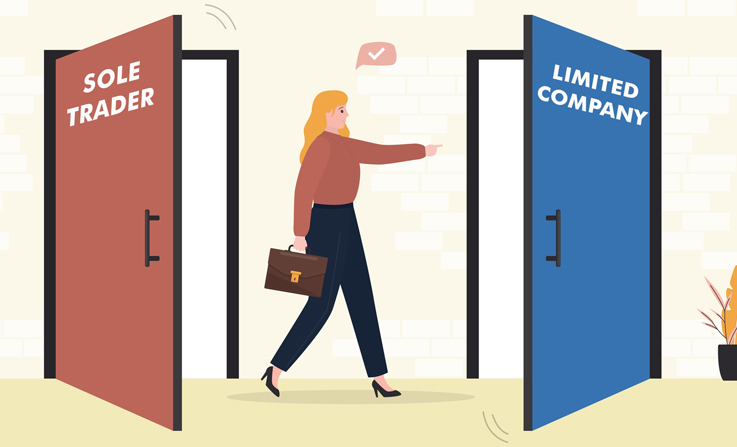
Many people in business move from sole trader to limited company as a natural progression when they grow after attracting more clients and customers.
Statistics reveal that in 2025, more companies were incorporated, some as a result of sole traders making the move to a limited company. Researchers believe that new tax rules, including Making Tax Digital for sole traders, may have helped fuel the increase.
If you’ve been running your business as a sole trader for a while, you might be starting to wonder whether it’s time to take the next step.
There is no single “perfect moment” to make the switch from sole trader to limited company. But there are some clear signs that can help you decide when the timing is right for you.
Here, we’ll unpack all you need to know.
What changes if I move to a limited company?
Before diving into the “when” it helps to quickly understand the difference.
As a sole trader, you and your business are legally the same entity. It’s simple, flexible, and great for getting started. You don’t even need a separate bank account as a sole trader. But it makes sense to open a business account as it can easily get confusing having to search all your transactions!
A limited company, on the other hand, is a separate legal entity. That means the business has its own finances, responsibilities, and importantly, liability. Even if you’re the only person in the business, you are seen as being employed by it. You become a director of that company.
It sounds like a big leap, but for many businesses, it’s a natural next step.
Signs it might be time to switch
Here are some of the most common indicators that moving to a limited company could make sense…
Your profits are increasing
Once you’re earning a steady and growing profit (often somewhere above £30,000–£50,000, depending on your situation), a limited company can become more tax-efficient.
You want to be more tax-efficient
Limited companies have more flexibility in how profits are taken through a mix of salary and dividends. This can reduce your overall tax bill.
1. You’re concerned about personal liability
As a sole trader, you’re personally responsible for any business debts. A limited company offers protection, meaning your personal assets are usually separate.
2. Your business is growing or taking on bigger contracts
Some clients and organisations prefer working with limited companies, as it can feel more established and professional.
3. You plan to bring in partners or investors
A limited company structure makes it easier to share ownership and attract investment.
It’s not just about money
While tax savings are often the headline reason people consider incorporating, they shouldn’t be the only factor.
Running a limited company does come with more responsibilities. You’ll need to:
- File annual accounts with Companies House
- Submit a corporation tax return
- Keep more detailed records
- Potentially run payroll (even if it’s just for yourself)
But with the right support these tasks are very manageable. And they are often less daunting than they first appear.
A perfect example
Here’s an example when moving from sole trader to limited company might work. Let’s say you’re a freelance designer. You started as a sole trader, your income has steadily grown, and now you’re consistently making £45,000-plus profit a year.
At this point, staying as a sole trader might mean you’re paying more tax than necessary. By switching to a limited company, you could structure your income more efficiently and potentially keep more of what you earn.
Plus, if you’re starting to work with larger clients, being a limited company might give you an extra edge in terms of credibility.
When should you make the move?
The right time is when the benefits clearly outweigh the extra responsibilities.
For many people, that happens when:
- Profits reach a level where tax savings become meaningful
- The business feels stable and likely to continue growing
- You’re ready to take on a slightly more structured way of working
But every situation is different. Your industry, income pattern, future plans, and even personal circumstances all play a part.
Don’t go it alone
This is one of those decisions where a bit of expert guidance can make a huge difference. We often find that a quick chat can clarify things almost instantly.
Sometimes it is the perfect time for you to move from sole trader to limited company. But there are other times when it’s not quite right.
Either way, you’ll leave with a clear plan.
We can help
If you’re even thinking about moving from sole trader to limited company, that’s usually a sign you’re on the right track and your business is growing.
If you’d like help figuring out what’s best for you, we’re always happy to talk things through. Just get in touch and we’ll be happy to help.